



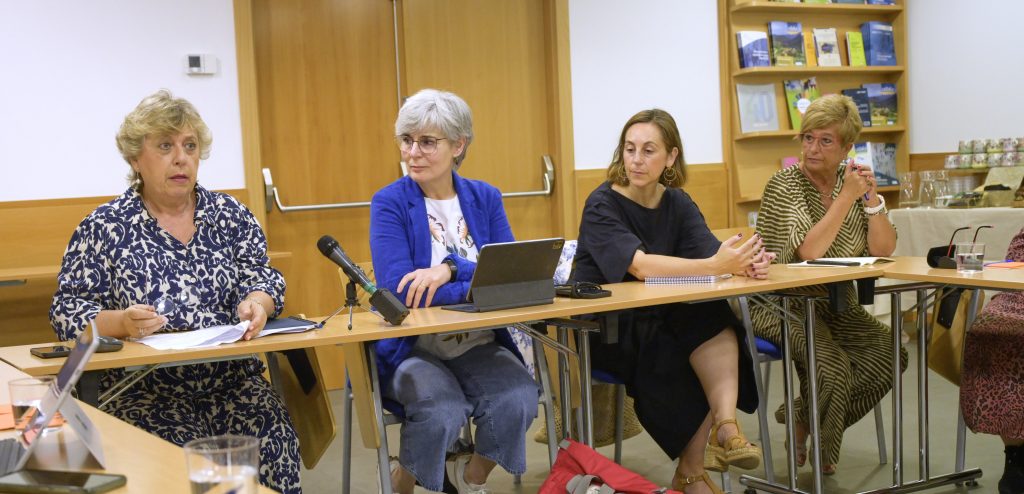
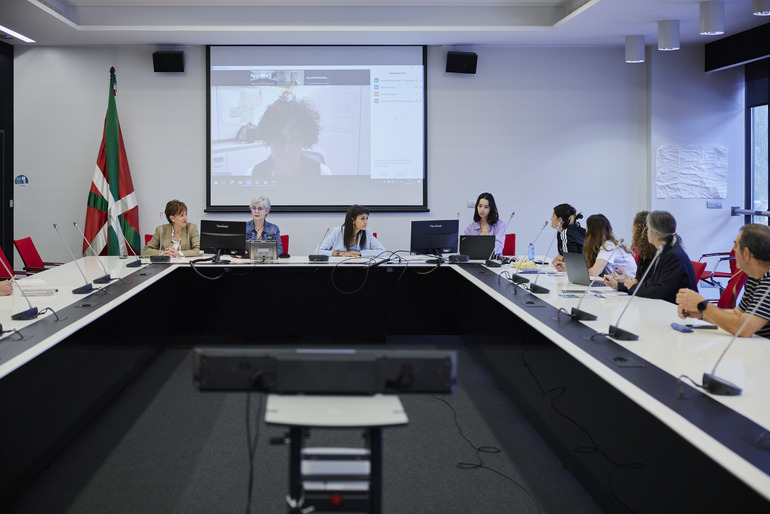
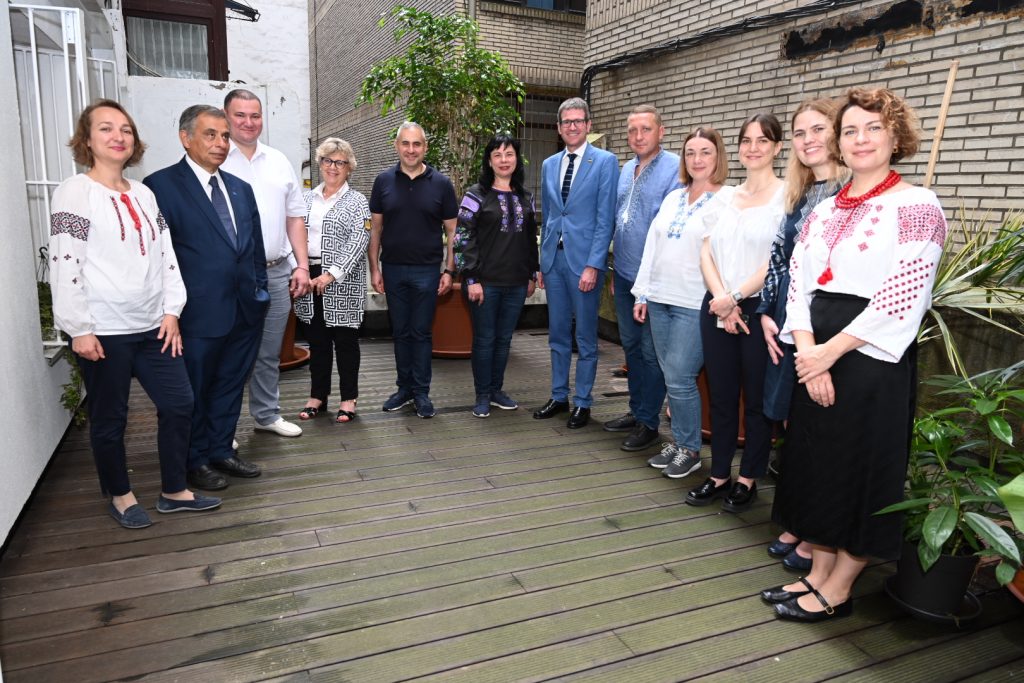
 Bilbao, 19 June 2023. This morning, the local authorities of Kremenchuk, Nikopol and Novomoskovsk met with the EUDEL Chairman, Gorka Urtaran and the association’s Managing Director, Mar Zabala, prior to the fact-finding visit by the Ukrainian delegation in the three Basque capitals this week. Bilbao, Donostia/San Sebastián and Vitoria-Gasteiz are taking part in the European “Bridges of Trust” project, driven by the European Commission, through the U-LEAD programme, to support the rebuilding of the cities devastated during the Russian invasion.
The Ukrainian delegate is made up of the Mayor and Deputy Mayor of Kremenchuk, Vitalii Maletskyi and Olga Usanova; the Deputy Mayor of Nikopol, Tetiana Obydenna; the Mayor of Novomoskovsk, Serhii Rieznik; and the manager of the Nikopol Vodokanal Water Consortium, Vitalii Dakov.
The municipal representatives are accompanied by the coordinators of the Association of Ukrainian Cities (AUC) and the Council of European Municipalities and Regions (CEMR), both of which are partner agencies of the initiative.
As he welcomed his counterparts, Chairman Gorka Urtaran expressed the Basque Municipalities’ solidarity with and steadfast commitment to the whole of people of Ukraine and to the local authorities that are protecting their citizens. “We believe in and support the “bridges of trust” between our respective peoples, convinced that the victory of the cities of Ukraine will also be the victory of European democracy and values. This cooperation project between municipalities is the very opposite of the confrontation between States; it symbolises the defence of our humanist values and principles: Human Rights, freedom, justice, equality, diversity, social cohesion, cooperation…”. Gorka Urtaran stressed the leading role of the municipalities when facing the challenges of environmental, economic and social sustainability: “The future of the planet lies in the towns and cities,” the Eudel Chairman pointed out.
 The meeting at EUDEL was an opportunity to learn firsthand of the experience of the Ukrainian councillors who are working in a state of war to protect their local communities and recover basic services for the population, such as the supply of drinking water, energy supply, reconstructing buildings and amenities, health, education, etc.
The Association of Basque Municipalities shared the Basque good practices with the Ukrainian authorities; they explained the Basque Government’s self-government framework in institutional and economic-financial terms, thanks to which they enjoy an advanced local development and social cohesion model.
Following the reception, the delegation then divided into three groups for the “twinning” with each Basque capital. Novomoskovsk with Bilbao, Nikopol with Vitoria-Gasteiz and Kremenchuk with Donostia/San Sebastián. The fact-finding visit will continue until Friday 23 June.
 EUDEL is one of the ten European associations selected to coordinate the project, in Eudel’s case in the Basque cities. Bilbao, Donostia/San Sebastián and Vitoria-Gasteiz have committed to this groundbreaking initiative based on “City to City” cooperation. Through the municipal facilitators – the Bilbao Bizkaia Water Consortium, AMVISA and Fomento San Sebastián -, they will provide technical support and expert advice to work together to design refurbishment and retrofitting infrastructure projects, along with the economic development and urban transformation, in the three cities devastated by the Russian invasion.
Related news item (ENG): https://noticias.eudel.eus/en/noticia/eudelek-eta-hiru-hiriburuek-europako-bridges-of-trust-proiektuan-parte-hartuko-dute-ukraina-berreraikitzen-laguntzeko/
Fact-finding mission 19-23 June
 After several online meetings, a delegation of local authorities from Novomoskovsk, Kremenchuk and Nikopol is in the Basque Country from 19 to 23 June to lay the foundation stone of their respective “bridges” with the three Basque capitals. The city councils Bilbao, Donostia/San Sebastián and Vitoria-Gasteiz are hosting host their Ukrainian counterparts, accompanied by representatives of the Association of Ukrainian Cities (AUC).
EUDEL is hosting host the opening and closing meetings on Monday 19 and Friday 23 June. On 20, 21 and 22 June, the Ukrainian delegation will divide into three groups. Each local authority will travel to their twinned Basque capital to hold bilateral meetings and work on the cooperation project in question.
The councils of the three capitals and the facilitators (CABB, AMVISA and Fomento San Sebastián) have designed their own programme of activities, which includes institutional meetings and visits to the cooperation project’s infrastructures, as well as to other iconic spaces and amenities of the city.

- The European Commission is the driving force behind this groundbreaking and solidarity initiative to set up 30 city-to-city partnerships between the EU and Ukraine.
- Bilbao and Novomoskovsk, Donostia/San Sebastián and Kremenchuk, and Vitoria-Gasteiz and Nikopol will work in partnership to help provide the Ukrainian population with basic services such as water and sanitation, or to drive urban and economic development after the war.
- Ukrainian authorities will travel to the Basque Country next week as part of a fact-finding mission to learn about the infrastructures and good practices of the three Basque capitals.
14 June 2023. EUDEL is one of the ten local government associations selected by the Council of European Municipalities and Regions (CEMR) to take part in the Bridges of Trust initiative, which will help to rebuild the Ukrainian cities most affected by the Russian attacks. The city councils of Bilbao, Donostia/San Sebastián and Vitoria-Gasteiz are on the list of 30 European cities that have stepped forward to support Ukraine.
A triple alliance has been set up in the Basque Country. Bilbao will work with Novomoskovsk and Vitoria with Nikopol, respectively; both cities are in the south-east region of Dnipro, the closest to Zaporizhzhia. Donostia will work with Kremenchuk in Poltava, in the central-eastern part of Ukraine.
Under the umbrella of the European Commission and the U-Lead with Europe programme, this is a groundbreaking and innovative experience in EU’s approach to city-to-city international cooperation. Coordination with the Association of Ukrainian Cities (AUC) and the different European associations is fundamental to forge local partnerships in each country.
In February this year, EUDEL embarked on this project, along with nine other associations: Spain, France, Italy, Sweden, Hungary, Poland, Slovenia, Latvia and Czechia. The Bridges value goes beyond ties of solidarity; its general goal is to join forces and involve the largest number of EU municipalities in the rebuilding. In turn, the aim is also to strengthen the capacities of local governments for the European integration of Ukraine.
U-Lead is focusing on the search for financing to drive and continue the cooperation projects with this medium- and long-term “roadmap”.
Cooperation Projects
The Basque Country-Ukraine cooperation will take the form of three specific rebuilding projects for each city: restoring the water supply and sanitation network, in the case of Bilbao and Vitoria, and economic development and urban transformation, in the case of Donostia.
The Basque capitals will be working with the Bilbao Bizkaia Water Consortium, AMVISA (Vitoria-Gasteiz Municipal Water Company) and the municipal company Fomento de San Sebastián on the projects. The technical team of each entity will provide its experience and good practices to advise its Ukrainian counterpart and design the project together. The aim is also to involve the partner agencies in the implementation phase.
Matching cities and war situation
- Bilbao – Novomoskovsk (69,855 inhabitants as o 1/1/2022)
Project: Rebuilding and improving the water supply, sewage and wastewater treatment networks. In consultation with Bilbao Bizkaia Water Consortium.
Novomoskovsk’s economic development has been bolstered by its vantage point at the crossroads of three industrial regions and of several communication routes – by water, rail and road -.
During the invasion, the heavy bombing of oil facilities and fuel tanks caused serious property damage, along with many dead and wounded.
- Donostia/San Sebastián – Kremenchuk (215,271 inhabitants as of 1/1/2022)
Project: Impetus and strategy for economic development, urban transformation and management of European projects. In consultation with Fomento de San Sebastián.
Important sectors in Kremenchuk’s economy are vehicle manufacturing and processing petroleum, and the city is well positioned along oil and gas pipelines. It also has two large universities, one public and one private.
The 27th of June will be the first anniversary of the missile strike on the largest shopping mall, which caused the highest number of dead in the city.
- Vitoria-Gasteiz – Nikopol (105,200 inhabitants as of 1/1/2022)
Project: Rebuilding and improving the water supply, sewage and wastewater treatment networks. In consultation with AMVISA.
Before the war, Nikopol was one of the largest industrial centres in Ukraine. It is on the Dnieper River, a short distance from the Zaporizhzhia nuclear power plant, a strategic point in the war. The latest serious attack was this June, with the destruction of the Kakhovka dam and of the hydroelectric power plant. The situation is a humanitarian and natural emergency, affecting the supply of drinking water and energy to the people of the region.
Fact-finding mission 19-23 June
After several online meetings, a delegation of local authorities from Novomoskovsk, Kremenchuk and Nikopol will be in the Basque Country from 19 to 23 June to lay the foundation stone of their respective “bridges” with the three Basque capitals. The city councils Bilbao, Donostia/San Sebastián and Vitoria-Gasteiz will host their Ukrainian counterparts, who will be accompanied by representatives of the Association of Ukrainian Cities (AUC).
EUDEL will host the opening and closing meetings of the visit on Monday 19 and Friday 23 June. On 20, 21 and 22 June, the delegation will be divided into three groups to hold the bilateral meetings and learn about the experience of each city.
The councils of the three capitals and the facilitators (CABB, AMVISA and Fomento San Sebastián) have designed their own programme of activities, which includes institutional meetings and visits to the cooperation project’s infrastructures, as well as to other iconic spaces and amenities of the city.