

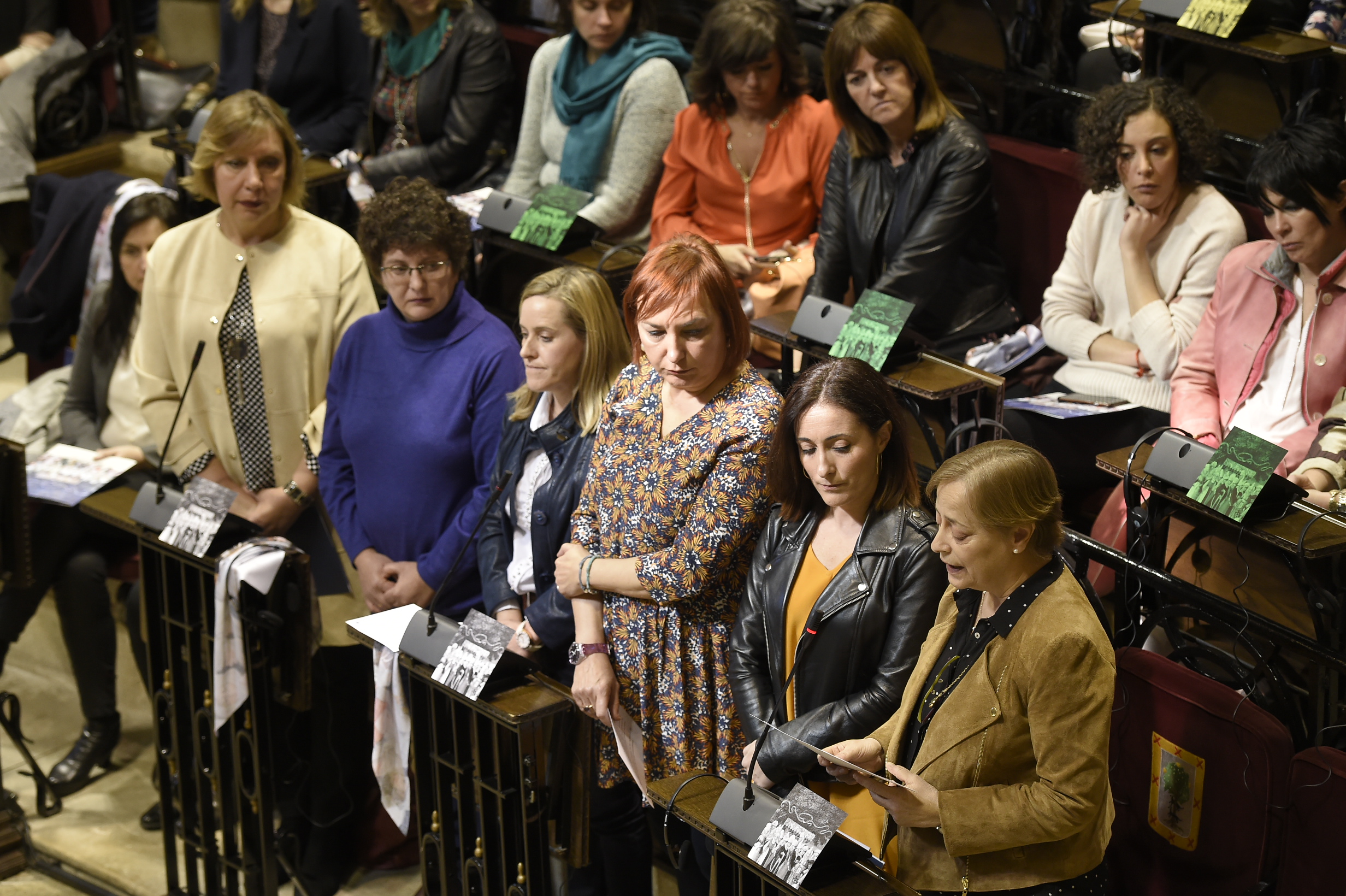
“Women are under-represented in political decision making at municipal level and face specific difficulties in accessing and participating in local politics in equal opportunities”, according to the Report presented by Inger Linge[1] at the 31st Congress of Local and Regional Authorities of the Council of Europe on women’s political participation and representation at local and regional levels, held on 20th October.
Balanced participation of men and women in decision making is a vital prior requirement for any democratic society. This is stated in the European Charter for Men and Women’s Equality in Local Life which encourages local governments to implement the necessary measures and strategies to promote balanced representation and participation of women and men in all local decision-making arenas.
Among these measures, article 23 of Law 4/2005 for the Equality of Men and Women enacted by the Basque Parliament also establishes that “all Basque public authorities must promote a balanced representation of duly qualified and skilled men and women in all appointments and recruitment processes of those who will become part of their management and public administration bodies. To achieve this, they will implement regulatory measures or any other measures as may be required.” The aforementioned Law also refers to a balanced presence of men and women in management bodies of associations and organisations of professional, corporate, social economy, trade union, political, cultural or any other nature, envisaging that Basque public administrations may adapt the corresponding aid to implement measures facilitating an increased presence of women in those management bodies where they are under-represented, while also preventing aid from being granted to associations and organisations which apply gender discrimination in their admission or operative processes.
Only 24.7% of municipal councils in the Basque Autonomous region are led by Mayoresses, who represent 18.82 % of the Basque population. In 2015, political parties opted to include women as lead candidates in only 32.58% of electoral lists. Regarding timing, women tend to be promoted at a slower pace and maintain leadership positions for shorter periods.
Only one of the leading Basque trade unions has a female General Secretary; while none of the four financial institutions based in the Basque Country has a female Chairperson and women’s representation accounts for just 22.6% in their main decision-making bodies.
Although no significant gender difference is found regarding the percentage of women and men participation in associations, women are the majority in associations related to traditional female roles, such as: education, religion, co-operation for development and social care associations; while their representation is less prevalent in sports, political, trade union, professional, art and residents’ associations.
On the other hand, women’s associations often operate with limited budgets and reduced influence capacity in municipal politics.
AWARE of this situation, the Council of ______________ undertaking the European Report recommendations, the commitments derived from the European Charter for Men and Women’s Equality in Local Life and the provisions set forth in Act 4/2005 for Women and Men Equality agrees to:
- ensure balanced representation of men and women in our consulting and decision-making bodies and in appointments for any local body positions so that both genders are represented by at least 40% (except for specific schemes aimed at promoting women’s participation);
- set up mechanisms to prevent elected female representatives being affected by stereotypes regarding competence or role assignation, as well as any other form of discrimination or harassment;
- implement measures aimed at reconciliating participation with personal and family life in terms of both working hours and methods, as well as care support systems;
- systematically collect, process and publish statistics broken down by gender to follow up the evolution of women’s participation at local level and develop corrective actions based on this analysis;
- reinforce spaces and networks to boost the participation of women such as Women’s Houses, Schools of Empowerment and/or Municipal Equality Councils; and facilitate access to programmes such as the school of empowerment for elected women ‘Virginia Woolf Basqueskola’;
- implement specific actions aimed at facilitating empowerment and promotion of socio-political participation for women in the municipality and in particular, including members of minority groups;
- ensure citizen participation processes carried out in the municipality take into account a gender perspective; and
- provide the necessary resources for equality areas as well as the other municipal areas to facilitate the implementation of these measures.
With the same aim of reinforcing social and political participation of women, we urge political parties to undertake these commitments and implement measures leading the way for other political and social actors.
[1] Inger Linge is the Gender Equality Rapporteur at the Congress of Local and Regional Authorities of the Council of Europe.